

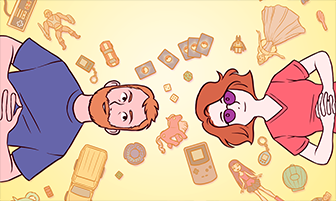

Jump Leads: Coming to an End
In July 2007, Jump Leads began its very first issue. In May 2012, it will be wrapping up its last.
This decision doesn’t come easily, or lightly, or any other words ending in ly, but it feels like the time has come.
We had a phenomenal first couple of years. We went from nearly no readers to tens of thousands. We published our first book. We attended three comic conventions worldwide including San Diego Comic-Con. However the last two or three years have been difficult, and it’s been tough to maintain that growth and momentum for a variety of reasons both personal and professional.
The Voyage Home was always going to be the end of an era for the comic; the end of the status quo and the beginning of a new arc. A new season, if you like. With the end of this comic specifically designed to serve as an act ending, it feels only right that we part ways here. We’ve made some changes to the script so that the story feels less like an abrupt ending and more like the true end of a chapter.
But what about now? Well, there are still a few pages left of The Voyage Home, and we’re going to try and deliver them to you at a rate of roughly one a week, if we’re able. I still want to record a couple of those Jump Leads audioplays, too. Beyond that I have no idea, but I hope you enjoy the rest of the ride with us.
Red Dwarf: Songs in the Key of Files
I realised today that the Red Dwarf fan-comic that Kris Carter and I produced, “Songs in the Key of Files”, never really had a place to call home. I’ve alternated between linking to the DeviantArt gallery for the comic and the thread over on Ganymede & Titan where it was showcased, but I’ve decided it’s probably a good idea to have a local copy of the comic. I’ve also added it to my Resume, because I’m exceptionally proud of it.
You can read “Songs in the Key of Files” here.
Office Space
If you are in the LA area and have an office space I can shoot in either in the evening/night or at the weekend, please let me know ASAP. Ideally something like a cubicle farm would be great, but at the least a professional-looking office environment with anywhere between two and five desks would be ideal.
Cheers in advance.
Upcoming Appearances
So I’m appearing at enough conventions this year to merit a shiny new Upcoming Appearances widget on the sidebar. I know! I’m just as surprised as you are!
At the moment I’ll be appearing at WonderCon in Anaheim, CA next month, San Diego Comic-Con in San Diego, CA this July, and the Geek Media Expo (or GMX) in Nashville, TN all the way out in October. I’d very much like to have a panel at this year’s PAX Prime in Seattle as well, but that’s in their hands, not mine.
It’s looking increasingly likely that I’ll be on at least one or two panels at GMX, with one focusing on videogame ports (for obvious reasons). What will the other panel focus on? I don’t know! Well actually, yes, I do, but it depends on whether or not the fine folks at GMX actually want me involved in that one. Still, they suggested it, so if I don’t get onto the panel then I shall pout.
This is my life now. It’s wonderful, and a little frightening.
No More Two-Parters in Doctor Who? Why I Don’t Think We Can Take Moffat at His Word.
WARNING: The following post contains spoilers for Doctor Who’s sixth series. You have been warned. I should also point out that, despite my employers’ connections with the BBC, I have zero foreknowledge of Series 7.
Oh no! Doctor Who showrunner Steven Moffat rocked the very foundation of the show by announcing way back in December that there probably won’t be any two-part stories in Series 7. This seems rather silly on the surface considering Moffat’s dedication and utter love for the show, but especially considering how vocal he has been about preserving the atmosphere of the show – the very reason he’s touted for deciding to move the series premiere from the traditional March/April start to some time in the Autumn.
Yet oddly, it’s that very reasoning that has me thinking that perhaps we can’t trust the words that tumbled from Moffat’s mouth last year, especially as he’s already proven himself to be an entirely untrustworthy showrunner. Moffat is very big on keeping secrets from the viewership, going so far as to intentionally mislead the public with announcements of stuff that definitely isn’t happening, which then goes on to happen.
I find it difficult to believe that Moffat would make a statement that effectively brings an end to part of Doctor Who’s enduring appeal. Although the serialized nature of the show has been toned down since its revival in 2005 the cliffhangers have remained an important part of the show. It’s not without good reason that Russell T Davies opted to include three two-part stories each series, a template Moffat kept for the show’s fifth series. Why, then, would he turn around and decide to abandon such an integral part of the show for its 50th anniversary?
Of course, looking at the second half of Series 6, it’s easy to see how he may approach the cliffhangers instead. “A Good Man Goes To War” and “Closing Time” are both great examples of stories that are ostensibly standalone, but that end with cliffhangers that either lead into or otherwise tease the next episode of the show. And what is the first fifteen minutes of “The Impossible Astronaut” if not a cliffhanger for the entire series?
Nevertheless, these cliffhangers are much less overt than in previous stories. Most viewers had more or less figured out that the impossible astronaut was River Song, and so the ending of “Closing Time” lost most of its impact before broadcast.
A good Doctor Who cliffhanger – a great Doctor Who cliffhanger, in fact – leaves the Doctor and/or his companions in a point of absolute peril, a dangerous scenario from which there appears to be no escape, perhaps best summed up by Moffat himself as “The monsters are coming.” In fact some of the show’s best cliffhangers since its return are Moffat’s own; “The Empty Child”, “Silence in the Library” and “The Pandorica Opens” are some of the most memorable and thrilling cliffhangers in the show’s history.
Reaching back even further, classic fan favourites like “The Caves of Androzani” and “Genesis of the Daleks” are defined as much by their episode climaxes as they are by the narrative itself, especially in the former story where the show plays with the audience’s expectation that the then-current Doctor, Peter Davison, is to die and regenerate.
Is Moffat really willing to discard such an important part of the show’s popularity? Or has Doctor Who outgrown the cliffhanger? I don’t know, but I wouldn’t bet money on our intrepid showrunner abandoning this staple just yet. Certainly not when there’s such a major anniversary on the horizon.
Mockumentality
I’m having an increasingly difficult time accepting the mockumentary premise of shows like The Office and Parks and Recreation, especially now that they’ve been on the air for a long time.
The problem is that these shows have increasingly become dram-coms (or “dramedies” if you hate yourself enough to use annoying portmanteaux), involving characters deceiving others, keepign secrets, harboring hidden feelings, that sort of thing. Which is fine, except the core conceit of the show actively prevents the deception and secrecy from working – namely, they’re being filmed for a television show which, if they don’t watch, their friends and family probably do.
This was less of an issue with the British version of The Office because it ran for twelve episodes, then dealt with exactly this thing in the Christmas special finale. Meanwhile the American version is midway through its eighth season, and we’re expected to believe that over the course of the last right years exactly none of the characters have learnt about secretive goings-on or caught loving glances from characters harboring secret crushes.
I love the mockumentary format, especially in both versions of The Office where the cameraperson almost becomes a character in their own right, but this failure to address a fundamental truth of the show’s universe makes it difficult for me to care about what’s going on in the show. By rights, they should know too, and if they know that what they’re doing may well be seen on national television, possibly by their friends, family or coworkers, they’d perhaps be a little less obvious about it.
Game Journalists Were Incompetent Fuckwits
Today I decided to wrap up Game Journalists Are Incompetent Fuckwits. I’ve been thinking about doing this for a couple of months now, and I had hoped to at least make it to the blog’s 2-year anniversary in February, but… y’know, my heart just isn’t in it anymore. Why kill myself doing something that just isn’t fun? Better to focus my time and energy on something I enjoy doing, like PortsCenter.
(Incidentally, have you seen the PortsCenter website lately? It’s looking pretty bloody good, I reckon. Go on, go have a look.)
A few people have asked me if I’m going to try and groom a successor. I find myself utterly perplexed by the question. It’s genuinely bonkers. No, of course I’m not.
So I Said to this Bloke…
It really pisses me off when people tell me that Texts From Bennett is fake. It’s not because I think the site is genuine – in fact I’ve no real opinion on the matter, largely because I don’t think it makes any difference either way.
Would it really be less funny if it were fake? Not really. It’s still funny, and whether I’m laughing at the inane thoughts of a genuinely baffled American teenager or piercing satire that veers into Poe’s Law territory, I’m still being entertained. I’m still laughing. At the end of the day, that’s all that really matters. If nothing else, as my sister points out, we grew up in a town where people talk more or less like Bennett practically all of the time in a wholly unironic fashion.
I have a similar reaction when people debate Karl Pilkington’s veracity. Is he genuinely that confused by life, or is he a character conceived by Ricky Gervais and Stephen Merchant, or possibly even Pilkington himself? Really, does it matter?
The people who will decry Texts From Bennett as being fake, or accusing Karl Pilkington of being a very talented fraud, are like people attending a live stand-up show and shouting, “This anecdote didn’t happen! He’s making it up!” – to whit, they’re fucking ridiculous. The audience doesn’t care whether or not Bill Bailey joined a Welsh experimental youth theatre group, or whether Dave Gorman actually uses 50 pence worth of stationary for truly evil purposes*. The audience isn’t there for facts. It’s not a bloody lecture.
What I’m saying is, if you look down on someone for having a bit of a giggle at a site like Texts From Bennett, then, y’know, basically, fuck off.
* I’d wanted to use a different example – part of Dave Gorman’s stand-up set where he lists a number of amusingly offensive puns his nephew suggested he say as part of his act – but it doesn’t appear to be on YouTube, and I’m not going to be the one to upload it. Suffice to say, you should buy Dave Gorman’s DVD “Stand Up. Live.” if you want to see it.


